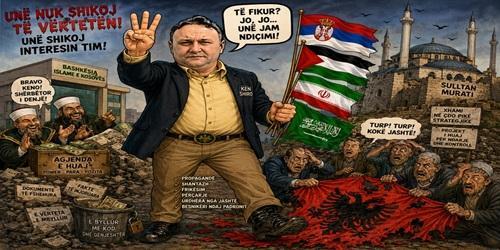
How Albanophobia Develops Through Religious Division in North Macedonia
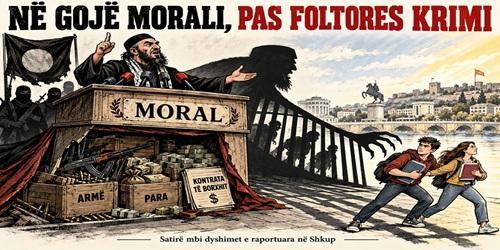
From "Islamic Terrorism" to "Albanian Orthodoxy": The Struggle for Albanian Identity in North Macedonia
In
North Macedonia, the conflict over Albanian identity does not take place only
in politics. It also operates through the language of security, the definition
of extremism, religious narratives, historical memory, and the way in which the
relationship between nationality and faith is defined.
On
the one hand stands the Muslim Albanian, who, in security discourse, risks
being reduced to the category of "Islamist," "radical," or
"jihadist." On the other hand stands the Orthodox Albanian, whose
identity challenges another nationalist equation: one that equates Orthodoxy
with Slavic, Serbian, or Macedonian belonging.
These
are two different mechanisms, but they ultimately lead to the same result:
defining the Albanian through religion rather than through their national
identity.
"Islamic
Terrorism" and the Case of Skopje
On
April 30, 2026, the National Security Agency, in cooperation with the Public
Prosecutor's Office for Prosecution of Organized Crime and Corruption and the
Ministry of Internal Affairs, carried out an operation in Skopje. According to
the NSA, the operation followed the identification of individuals and a
logistical network that, according to the agency's operational data, was linked
to a radical group inspired by the global Islamic State network.[1]
The
authorities linked the operation to an attempt to burn a property belonging to
the Jewish Community in Skopje and to violent activities undertaken following
an ISIS call at the beginning of April.[1]
On
June 17, 2026, the Prosecutor's Office announced another case. Five people from
Skopje, aged between 22 and 34, were placed under investigation for the
criminal offense of "terrorist organization." According to the
Prosecutor's Office, the group had been formed online at the end of 2024 and,
during 2025–2026, had distributed materials promoting the ideology of ISIS and
other terrorist organizations ideologically linked to it.[2]
In
this case, the institutions have been clear: these are concrete investigations,
concrete individuals, concrete materials, and concrete criminal offenses.
But
this is precisely where the broader problem of public discourse begins.
An
Albanian individual suspected of terrorism does not represent Albanians. A
group propagating ISIS does not represent Islam. And the fight against
terrorism cannot be transformed into a fight against an ethnic identity.
This
is the dividing line that security institutions must preserve, while journalism
must scrutinize it.
Because
when a religious category and an ethnic category begin to be used as synonyms,
individual terrorism is transformed into collective stigmatization.
The Albanian Does Not
Begin and End with Religion
The
history of Albanians in North Macedonia makes any definition of Albanian
identity through a single religion impossible.
Albanians
of this territory have been and are Muslim, Orthodox, and Catholic.
One
of the strongest pieces of evidence can be found in Upper Reka.
The
Orthodox Albanian communities of Reka have been documented in historical
literature and public testimony. Branko Manojllovski has openly articulated his
identity as Albanian and Orthodox, speaking about a history in which Muslim and
Orthodox Albanians lived in the same space.[3]
This
is not merely a matter of individual memory.
The
official register of the Commission for Relations with Religious Communities
and Religious Groups of North Macedonia includes the Religious Community of
Orthodox Albanians in the Republic of Macedonia.[4]
Therefore,
the Orthodox Albanian is not a theoretical construct.
It
is an identity publicly declared and recognized in the state register of
religious communities.
Josif Bageri and Reka
That Was Not Divided by Religion
Josif
Bageri also occupies a place in the history of this region.
Born
in Nistrovo in Upper Reka, Bageri was an activist of the Albanian National
Renaissance and part of the efforts for the development of Albanian education
and culture.[5]
His
importance for this analysis lies precisely in the fact that the history of
Reka cannot be reduced to the division of Albanians according to religious
affiliation.
The
Albanian Renaissance treated language and national consciousness as elements
capable of uniting Albanians beyond religious differences.
This
makes Reka a historical counterargument to any ideology seeking to construct
the equation:
Muslim
= Albanian; Orthodox = Slavic.
This
equation does not correspond to the history of the Albanians of the Balkans.
Constantine and
Christianity Before Nationalism
Another
element that must be placed in perspective is the history of early
Christianity.
Constantine
the Great is associated with Naissus, the ancient city now known as Niš. He was
one of the fundamental figures in the history of fourth-century Christianity
and convened the Council of Nicaea in 325.[6]
But
Constantine cannot be treated as the "founder of the Orthodox Church"
in the modern institutional sense. The concepts of national churches and the
Catholic–Orthodox division belong to much later periods.
This
distinction is fundamental.
Fourth-century
Christianity was not the national property of Serbs, Macedonians, or Albanians.
Balkan
nationalism is a much later phenomenon.
Therefore,
when a universal religious tradition begins to be defined as the exclusive
property of a nation, we have moved from faith to the nationalization of
religion.
The Serbian Church, the
Macedonian Church, and the Conflict over Identity
The
history of the Serbian Orthodox Church and the Macedonian Orthodox Church
demonstrates that the church question in the Balkans has long had a national
and political dimension.
The
conflict over the status of the Macedonian Church was not merely a canonical
dispute. It developed in a space where religion, language, territory, and
national identity were intertwined.
The
Serbian Orthodox Church itself, in its statement of May 16, 2022, recalled that
the interruption of canonical communion had followed the unilateral declaration
of autocephaly by the Macedonian Church in 1967.[7]
But
history took an important turn in 2022.
The
SOC restored liturgical and canonical communion with the Macedonian Church and
subsequently recognized its autocephaly.[7][8]
This
fact should not be overlooked.
It
shows that the institutional conflict between the SOC and the MOC cannot today
be used as evidence that the SOC continues to exercise institutional control
over the Macedonian Church.
But
it does not erase the history of the nationalization of religious identities in
the region.
Nor
does it close the other question: what happens to the Orthodox Albanian within
spaces where Orthodoxy has historically been linked to Serbian or Macedonian
national projects?
The Nationalization of
Religion and the Problem of the Orthodox Albanian
The
nationalization of religion operates through a simple mechanism: religion is
used as a marker of nationality.
If
Orthodoxy is defined as exclusively Serbian or Macedonian, then the Orthodox
Albanian becomes an uncomfortable exception to this scheme.
But
the history of Reka overturns this exception.
The
Orthodox Albanian exists.
He
has existed historically.
He
has publicly declared his identity.
And
an Orthodox Albanian community appears in the state register.
Thus,
the problem does not lie with the Orthodox Albanian.
The
problem appears only when someone seeks to tell him which identity he should
choose.
If
an Albanian is told that, because he is Orthodox, he must be Serbian or
Macedonian, then religion is being used as a mechanism for changing or denying
national identity.
This
is precisely the form of division that must be examined.
From Religious Division
to Albanophobia
Albanophobia
does not necessarily appear only through direct statements against Albanians.
It
can also appear through the way in which the Albanian is constructed in
discourse.
The
Muslim Albanian may be reduced to an "Islamist."
The
Orthodox Albanian may be reduced to a "Macedonian" or
"Serb."
In
both cases, Albanian identity is weakened.
In
the first case, the Albanian is presented as a security risk.
In
the second case, the Albanian disappears as a national subject.
This
is the core thesis of this article:
Religious
division is not simply a division between two religious communities; it can be
used to fragment Albanian identity itself into categories that can be
controlled, stigmatized, or appropriated by other national narratives.
The Russian and Serbian
Dimension of Information Warfare
At
this point, the dimension of hybrid warfare enters the discussion.
The
Institute of Communication Studies in Skopje has documented that North
Macedonia is part of an environment in which foreign information manipulation
and interference operations, known as FIMI, exploit social vulnerabilities and
existing conflicts in order to influence public perceptions.[9]
In
its specific study on Russian FIMI in North Macedonia, the institute emphasizes
that the Western Balkans constitute an important terrain for Russian influence
operations and that bilateral tensions and internal conflicts can be used to
amplify influence narratives.[9]
This
is important for the analysis of religious division.
An
influence operation does not need to create a conflict from scratch.
It
is enough to find an existing dividing line and deepen it.
In
North Macedonia, one of the most sensitive dividing lines is the one connecting
ethnicity, religion, and national identity.
Niš as Part of the
Russian-Serbian Mosaic
In
this context, the Russian-Serbian Humanitarian Center in Niš cannot be left out
of an analysis of Russian-Serbian influence in the Balkans.
The
Center is officially presented as a Russian-Serbian humanitarian structure
focused on responding to disasters and emergencies.[10]
Nevertheless,
its role has for years been the subject of political and security debate.
For
this reason, Niš should not be viewed as evidence of an "operational
center" controlling events in Skopje, but as one of the institutional
nodes of Russian-Serbian relations around which a broader debate over influence
and security has developed.
This
is consistent with broader analyses of FIMI and Russian influence in the
Balkans.
But
one thing must be stated clearly: none of these sources proves that the Niš
Center directed the counterterrorism operations in Skopje.
Serious
journalism does not need such an unproven connection.
It
is enough to document the mechanism of influence and then follow the traces.
The
Struggle for Albanian Identity Also Takes Place Within Orthodoxy
This
is the point at which the issue takes on its deepest dimension.
For
many decades, Albanian identity in the Balkans has been interpreted through
religion. The Albanian has been imagined as Muslim; the Albanian Catholic has
been treated as an exception; while the Orthodox Albanian has often been made
even more invisible.
But
this history does not correspond to reality.
Upper
Reka is evidence.
Josif
Bageri is evidence.
Branko
Manojllovski is evidence.
The
state register of religious communities is evidence.
The
history of Albanians of different faiths is evidence.
This
is why the Orthodox Albanian has significance far greater than a local
religious debate.
He
overturns the idea that religion determines the nation.
And
precisely for this reason, his identity becomes a political and cultural
battleground.
Conclusion
Modern
Albanophobia should not be sought only in the direct vocabulary used against
Albanians.
It
can also appear through the way Albanians are classified.
The
Muslim Albanian is reduced to a potential security risk.
The
Orthodox Albanian is separated from Albanian identity and pushed toward another
national identity.
In
both cases, Albanian identity loses its complexity.
Therefore,
the struggle over Albanian identity in North Macedonia is simultaneously a
struggle against two reductions: against reducing the Albanian to a Muslim and
against reducing the Orthodox person to a Serb or Macedonian.
These
two mechanisms are not the same, but they can produce the same political
effect: the division of Albanians along religious lines.
In
this sense, Reka is not merely a chapter of local history. It is a
counterargument to every project that links nationhood with religion.
Josif
Bageri is not merely a figure of the Renaissance. He is evidence that Albanian
identity and Orthodoxy have not been incompatible identities.
And
the Orthodox Albanian of today is not a paradox.
It
is a continuation of a reality that existed long before modern Balkan
nationalisms turned religion into a national boundary.
If
North Macedonia wishes to be a civic and multiethnic state, then the principle
should be simple:
Religion
does not determine the nation, nor should the nation determine religion.
Any
attempt to do the opposite creates fertile ground for division.
And
precisely there, in the space between religion, nationalism, security, and
identity, the mechanism through which Albanophobia can take new forms must be
sought.
Footnotes
[1]
National Security Agency of the Republic of North Macedonia, statement on the
April 30, 2026 counterterrorism operation and the identification of a radical
group ideologically linked to the global ISIS network.
[2]
Public Prosecutor's Office for Prosecution of Organized Crime and Corruption,
"Five Persons Under Investigation for Terrorist Organization," June
17, 2026.
[3]
For Orthodox Albanians of Reka and the public statements of Branko
Manojllovski, see academic literature and his public interviews concerning
Albanian and Orthodox identity.
[4]
Commission for Relations with Religious Communities and Religious Groups of the
Republic of North Macedonia, official register of religious communities.
[5]
Historical literature on Josif Bageri and his activities in the Albanian
National Renaissance; Bageri was from Nistrovo in Upper Reka and worked for
Albanian education and culture.
[6]
Historical and academic sources on Constantine the Great, Naissus, and the
Council of Nicaea of 325.
[7]
Serbian Orthodox Church, statement of the Holy Synod/Holy Assembly of May 16,
2022, on the restoration of canonical and liturgical communion with the
Macedonian Orthodox Church.
[8]
Serbian Orthodox Church, official documentation concerning the recognition of
the autocephaly of the Macedonian Orthodox Church in 2022.
[9]
Institute of Communication Studies, Russian FIMI in North Macedonia: Exploiting
Vulnerabilities Through Bilateral Disputes, November 13, 2025.
[10]
Russian-Serbian Humanitarian Center, official documents concerning the
establishment and function of the Center in Niš.
Prishtina, 28.09.2026
Të Tjera