The League of Prizren (1878): The Awakening of National Consciousness and the Historical Path toward Albanian State Sovereignty
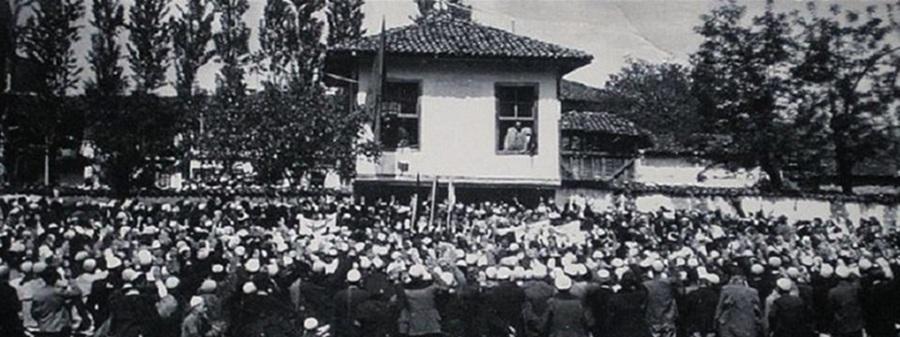

From
the call for the defense of Albanian territories in the 19th century toward the
constitutional institutionalization of the unity and territorial integrity of
the modern Albanian state
Preface
The
League of Prizren (1878) constitutes one of the most important moments in
Albanian political history and in the process of shaping their national
consciousness. It should not be understood simply as an isolated historical
event, but as a complex political, social, and diplomatic process, which
developed during a period when the international order in the Balkans was being
radically reconfigured following the decisions of the Congress of Berlin.
In
this historical context, Albanians were confronted with a new geopolitical
reality, where the decision-making of the Great Powers had a direct impact on
the territorial and political fate of local populations. The League of Prizren
emerged as an organized response to this reality, reflecting the need for the
defense of Albanian territories and the articulation of a common political stance.
This
paper aims to analyze the League of Prizren from an advanced historical-legal
perspective, placing it in direct relation to the development of the modern
Albanian state and its contemporary constitutional order. The aim is not only
the description of the event in a narrative historical aspect, but also its
interpretation in light of theories of the state, sovereignty, and
constitutional law.
In
this framework, the League of Prizren is treated as an early form of political
and institutional mobilization of Albanians, which marks the transition from a
predominantly ethno-cultural consciousness toward a more structured political
consciousness. However, in terms of modern law, it does not constitute a
consolidated state subject, but a historical organization with a defensive and
representative character, which must be read in the context of the limitations
of the time.
The
analysis of this paper is based on the classical literature of Albanian and
international historiography, as well as contemporary theories on nationalism
and the state, in order to provide a deeper understanding of the connection
between the historical process of nation formation and the institutionalization
of state sovereignty.
At
the contemporary level, the importance of the League of Prizren does not lie in
its function as an institutional model, but in its symbolic and interpretative
value within collective historical memory. It serves as a point of reference
for understanding the development of the idea of unity, sovereignty, and
territorial integrity, which today are embodied in the constitutional order of
the Republic of Albania.
In
this way, the paper aims to build an analytical bridge between the historical
past and the legal present, treating the League of Prizren as a fundamental
element of the continuity of Albanian political thought and the construction of
the modern state.
Abstract
This
paper analyzes the League of Prizren as a fundamental phenomenon of Albanian
political history and places it in relation to the development of the modern
state and the contemporary constitutional order of the Republic of Albania. By
combining historical perspective, political theory, and legal analysis, it
addresses the transformation of the concept of territorial defense from a form
of collective mobilization into an institutionalized principle of state
sovereignty.
1.
Historical Context: The Critical Moment of National Existence
The
League of Prizren was established on 10 June 1878, in one of the most critical
periods for Albanians in the Balkans, when after the Congress of Berlin (1878)
the borders of the Ottoman Empire were revised and the reorganization of
spheres of influence of the Great Powers was decided.¹
In
this context, Albanian territories faced a real risk of political and administrative
fragmentation. According to Noel Malcolm, this period is characterized by
"international decision-making that did not reflect the ethnic reality of
the region."²
From
the perspective of political history, the League of Prizren represents:
a
collective act of territorial defense,
an
effort for political self-organization,
and
an early form of articulation of national sovereignty.
According
to Stavro Skëndi, it constitutes "the moment when Albanian identity shifts
from ethnographic to political."³
2.
Political Dimension: From Ethnic Community to Political Subject
In
modern theories of nationalism, Benedict Anderson defines the nation as an
"imagined community" created through institutions and political
communication.?
In
this sense, the League of Prizren represents:
an
initial structuring of this "political imagination,"
an
attempt at territorial coordination,
and
a proto-representational political form.
However,
it remained outside the model of the modern legal state, because it did not
have:
consolidated
sovereignty,
a
centralized state apparatus,
international
recognition.
3.
Historical Transition toward the Modern Albanian State
With
the declaration of independence in 1912 and the development of state
institutions, the concept of territorial defense was radically transformed:
from
historical mobilization ? into a
constitutional obligation
from
collective political action ? into an
institutional state competence
This
transformation represents the shift from the logic of historical resistance to
the logic of institutionalized legal sovereignty.
4.
Constitutional Framework of the Republic of Albania
Article
1
"Albania
is a parliamentary republic."?
This
article defines the form of the state and the legitimacy of public power
through democratic representation.
Article
2
"Sovereignty
in the Republic of Albania belongs to the people."?
This
article establishes the people as the source of all state authority.
Article
3
"The
independence of the state and its territorial integrity are its
foundation."?
This
is one of the most important constitutional provisions, enshrining the
inviolability of territory as an absolute constitutional principle.
Article
4
"The
rule of law is the basis of its activity."?
This
article guarantees that all state actions must be based on law.
Article
5
"The
Republic of Albania applies binding international law."?
This
article integrates Albania into the international legal order.
5.
Criminal Framework: Legal Protection of Sovereignty
The
Criminal Code of the Republic of Albania provides special protection for:
constitutional
order,
territorial
integrity,
and
national security.
Acts
that violate these values are included in the chapters on crimes against the
state, including treason against the homeland.¹?
In
legal doctrine, these acts are considered "crimes of maximum social
danger," as they affect the very existence of the state.
Hans
Kelsen emphasizes that "the state is identical to its legal order,"
meaning that any violation of the legal order is a violation of the state
itself.¹¹
6.
The League of Prizren in Modern Constitutional Perspective
From
the perspective of modern constitutional law, the League of Prizren does not
have a legal state character, but it has:
historical-constitutional
value,
identity
value,
and
symbolic value in constructing state narrative.
In
this sense, it is not a normative source, but a historical interpretative
source of Albanian political identity.
7.
Patriotic and Historical Dimension: Collective Memory
In
the historical and sociological dimension, the League of Prizren represents one
of the highest moments of Albanian collective mobilization in modern history.
According
to Fischer, it is "one of the earliest attempts of Albanian political
organization in unfavorable international conditions."¹²
It
symbolizes:
historical
resistance,
political
unity,
and
awareness of national existence.
8.
International and Comparative Interpretation
Internationally,
the League of Prizren can be compared with other 19th-century national movements
such as:
Italian
unification (Risorgimento),
German
unification,
and
liberation movements in the Balkans.
In
this sense, it is part of the broader wave of formation of modern nation-states
in Europe.
9.
Conclusions
The
League of Prizren represents a fundamental moment in Albanian history, where
national identity began to take organized political form.
In
the contemporary Albanian state:
it
has no legal function,
but
it has a historical-identity and interpretative function,
while
the principles it symbolizes are institutionalized in the Constitution and the
legal order.
In
this sense, there is a historical continuity between:
the
resistance of the 19th century,
and
the constitutional sovereignty of the modern Albanian state.
Footnotes:
1.
Congress of Berlin (1878), Diplomatic Acts of the Great Powers
The
Congress of Berlin was an international diplomatic conference convened after
the Russo–Turkish War (1877–1878), with the purpose of revising the Treaty of
San Stefano and restructuring the political order in the Balkans. The Congress
represented a key moment in 19th-century European diplomacy, where the Great
Powers (including Britain, France, Austria-Hungary, Germany, Russia, and the
Ottoman Empire) negotiated territorial arrangements based on strategic balance
rather than the principle of national self-determination. In this context, the
Albanian question was not recognized as a distinct political subject, which had
significant consequences for the territorial configuration of
Albanian-inhabited regions.
2.
Noel Malcolm, Kosovo: A Short History, Macmillan, 1998
Noel
Malcolm is a British historian specializing in Balkan history. In this work, he
analyzes the historical development of Kosovo and the broader Albanian-inhabited
territories within the Ottoman and post-Ottoman context. His central argument
emphasizes that many decisions taken by European powers in the 19th and 20th
centuries often failed to reflect the actual ethnic and demographic realities
of the region, contributing to long-term political instability and unresolved
territorial disputes in the Balkans.
3.
Stavro Skëndi, The Albanian National Awakening, Princeton University Press,
1967
Stavro
Skëndi is regarded as one of the most important scholars of Albanian national
history. His study analyzes the Albanian National Awakening as a gradual
process of political and cultural transformation. He interprets the League of
Prizren as a decisive turning point in the shift from a fragmented local and
religious identity toward a more unified and politically articulated national
identity. The work remains a foundational reference in Albanian historiography.
4.
Benedict Anderson, Imagined Communities: Reflections on the Origin and Spread
of Nationalism, Verso, 1983
Benedict
Anderson develops the influential theory of the nation as an "imagined
community," arguing that nations are not natural or ancient entities, but
historically constructed social formations created through shared language,
print culture, and modern institutions. Within this theoretical framework,
nationalist movements such as the League of Prizren can be understood as early
manifestations of modern nation-building processes.
5.
Constitution of the Republic of Albania, Article 1
This
article defines Albania as a parliamentary republic and establishes the
fundamental framework of state organization based on democratic representation.
It sets the basic structure of political authority within the constitutional
order.
6.
Constitution of the Republic of Albania, Article 2
This
provision establishes the principle of popular sovereignty, declaring that all
state power derives from the people and is exercised through democratically
elected institutions. It is a core principle of modern constitutional
democracy.
7.
Constitution of the Republic of Albania, Article 3
This
article guarantees the independence of the state and the inviolability of its
territorial integrity. It is considered one of the foundational pillars of the
constitutional order and represents a core principle defining the existence and
continuity of the state.
8.
Constitution of the Republic of Albania, Article 4
This
provision establishes the principle of the rule of law, requiring that all
state activity be based on law and subject to legal accountability. It is a
cornerstone of constitutional governance and democratic legality.
9.
Constitution of the Republic of Albania, Article 5
This
article obliges the Republic of Albania to respect and apply binding
international law. It integrates the domestic legal system into the
international legal order, ensuring compatibility between national legislation
and international obligations.
10.
Criminal Code of the Republic of Albania (provisions on crimes against the
state)
The
Criminal Code includes a specific section dedicated to crimes against the
state, covering acts that threaten constitutional order, national security, and
territorial integrity. These provisions are designed to protect the stability
of state institutions and are classified as offenses of high social danger.
11.
Hans Kelsen, Pure Theory of Law, University of California Press, 1960
Hans
Kelsen is the founder of the Pure Theory of Law and one of the most influential
legal theorists of the 20th century. According to his normative theory, the
state is not a political entity separate from law, but is identical to its
legal order. This conception is fundamental to modern legal understandings of
sovereignty as a juridical rather than purely political concept.
12.
Bernd J. Fischer, Albania at War 1939–1945, Purdue University Press, 1999
Bernd
J. Fischer is an American historian specializing in modern Albanian history.
His work analyzes the political and military developments of Albania during the
Second World War, offering a broader perspective on the processes of state
formation and institutional development in modern Albania.
The
Land of Leka, 10.06.2026
Të Tjera