Zemra Shqiptare
 https://www.zemrashqiptare.net/
https://www.zemrashqiptare.net/
| E marte, 27.01.2026, 06:55 PM |
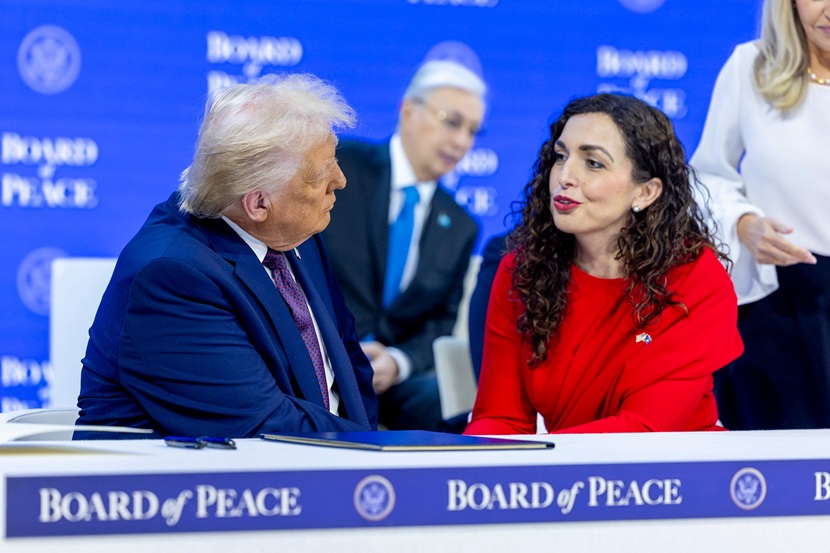
President Vjosa Osmani and the Strategic Value of Continuity in U.S.–Kosovo and EU–Kosovo Relations
 By
Frank Shkreli*
By
Frank Shkreli*
As
Kosova approaches its next presidential mandate, continuity matters. President
Vjosa Osmani’s re-election would serve not only Kosova’s democratic
development, but also the strategic interests of the United States and the
European Union. President Vjosa Osmani should be re-elected because she has
given Kosova something rare in its recent political life: credibility, dignity,
and clarity.
Kosovo’s
relationship with the United States and the European Union has long been
anchored not only in shared interests, but in shared democratic values. In this
context, the re-election of President Vjosa Osmani would represent continuity,
reliability, and strategic coherence at a moment of heightened uncertainty in
the Western Balkans.
For
U.S.- Kosova relations, Vjosa Osmani is a trusted Democratic partner. Kosova’s
relationship with the United States and the European Union has long been
anchored not only in shared interests, but in shared democratic values. In this
context, the re-election of President Vjosa Osmani would represent continuity,
reliability, and strategic coherence at a moment of heightened uncertainty in
the Western Balkans. Her leadership contrasts sharply with the populism and
institutional erosion seen elsewhere in the region. For Washington, President
Osmani has proven to be a predictable and principled partner. She has
consistently framed Kosova’s priorities in terms familiar to U.S. policymakers:
constitutional order, democratic accountability, and Euro-Atlantic alignment.
Under
President Osmani’s presidency, Kosova has remained firmly pro-American, without
ambiguity or transactional posturing. Democratic institutions have been
defended against political capture. Kosova’s standing in Washington has shifted
from crisis management to institutional maturity. Osmani’s leadership style — disciplined,
constitutional, and non-provocative — reinforces Kosova’s image as a serious
partner, not a source of instability requiring constant mediation. Her re-election
would reassure U.S. stakeholders that Kosova remains firmly aligned with the
strategic vision, the United States has supported since 1999 for the country.
For
the European Union, President Osmani has embodied the standards Brussels
expects but too rarely sees applied consistently across the region. She has
emphasized respect for the Constitution and the separation of powers, judicial
independence and the rule of law. For minority rights grounded in law, not
political expediency. At a time when EU credibility in the Western Balkans is strained,
Kosova under Osmani has remained constructive without surrendering sovereignty
— cooperative without abandoning principles. Her presidency has helped position
Kosova as a norm-compliant European democracy, despite slow and often
frustrating accession dynamics.
Why
Osmani’s re-election matters for the Transatlantic Community?
Re-electing
President Osmani would send a clear and constructive signal to Washington and
Brussels: Kosova values institutional stability over political volatility.
Democratic leadership is rewarded, not sidelined. The presidency remains a
constitutional anchor, not a partisan instrument. In a region increasingly
exposed to external influences and democratic backsliding, leadership
continuity in Kosova matters. She has consistently aligned Kosova with
Euro-Atlantic democratic norms, even under internal pressures. Osmani offers
stability without stagnation and firmness without escalation — precisely the
balance the transatlantic community seeks in the Western Balkans.
In
conclusion, President Vjosa Osmani’s re-election would not simply be a domestic
political decision. Her re-eletion would be a strategic affirmation of Kosova’s
continuing alignment with the United States and the European Union — and a
reaffirmation of its commitment to democratic governance, the rule of law, and
Euro-Atlantic values. For Kosova’s partners, continuity with Vjosa Osmani as
President of Republic of Kosova means clarity, credibility, and confidence. At
a time when the Western Balkans face renewed geopolitical pressure, Kosova
cannot afford uncertainty at the top of its constitutional order. Osmani’s
presidency has provided stability without stagnation, with firmness without
provocation. For Kosova’s partners in Washington and Brussels, her re-election
would represent a predictable values-based continuation — and a reaffirmation
that Kosova’s democratic trajectory remains intact.
---------------
*Frank Shkreli, a
retired former Director of VOA’s European Division, is a public commentator on
transatlantic relations and Balkan affairs. Shkreli writes on U.S.–Kosovo and
U. S.-Albanian relations, European integration, and democratic governance in
the Western Balkans. His work focuses on historical memory, institutional
democratic development, media freedom and the rule of law in former communist
countries.